
At Edward Street, we’re committed to ensuring that all children can enjoy a rich, supportive childhood. To make that vision a reality, it’s important to understand how children learn and grow.
Through this series, we’ll share information about four key topics in child development: ecological systems theory, brain building, developmental relationships, and toxic stress & resilience. We’ll explore these topics separately, but they are all interconnected. With this information in hand, you can better understand and support children in your life or make positive changes that impact children in our community.
Ecological Systems Theory: What Surrounds Us Shapes Us

To begin thinking about the science of early childhood development, I’ll quickly introduce you to developmental psychologist Urie Bronfenbrenner. In the mid-twentieth century, his work revolutionized the way we think about human development. Previously, psychologists focused heavily on individual traits and laboratory experiments conducted outside of children’s everyday environments; Bronfenbrenner called this age of developmental psychology “the science of strange behavior of children in strange situations with strange adults for the briefest possible periods of time.” This is simply not a reflection of the kind of environments children grow up in!
With his Ecological Systems Theory, Bronfenbrenner explains that development doesn’t happen in a vacuum; children grow within networks of relationships, in built and natural environments, and social and cultural contexts that intersect to impact a child’s development. Thanks to his work, when thinking about early childhood development, we now know the importance of considering the child’s full developmental environment.
The Center on the Developing Child refers to this idea as “What Surrounds Us Shapes Us.” This updated model considers how a wide range of influences in a child’s environment – social relationships, safe housing, polluted air, access to high-quality early education and care – can have lasting impacts on the development of their brain and body, with long-term consequences for health and wellbeing.
We also now recognize the inequities in the environments children grow up in. Structural racism is deeply embedded in our past and present, and continues to shape conditions children grow up in. This has caused many children of color and children from low-income families to be living in environments with poorer conditions and less access to opportunities. To create a world where all children thrive, attending to these inequities is essential.
In A Little More Detail
In Ecological Systems Theory, there are five layers of influence, typically represented as circles nested within one another. Each layer gets further from the child’s direct experience; the first layer is those direct relationships a child has with others (such as a parent), the next is the relationships between those in the first layer (such as between a parent and a child’s teacher), the third is external influences (such as the parent’s workplace), and so on.
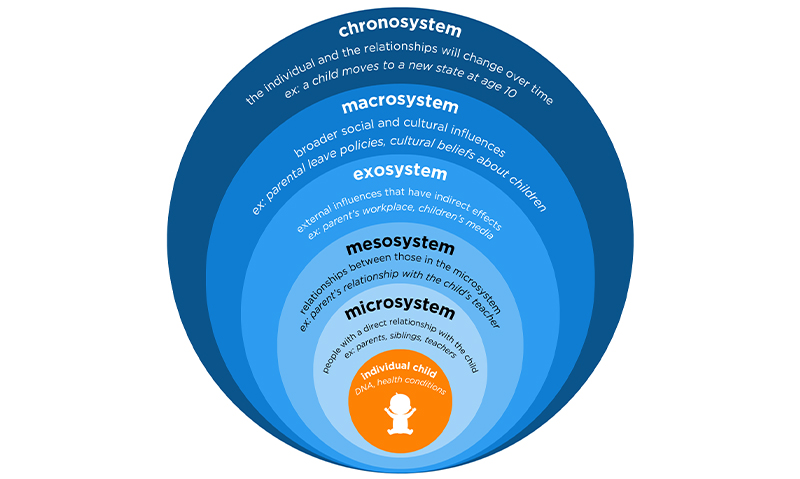
The outermost layer describes the impact of time. Timing is an important variable in early childhood. Children have critical periods when their brain expects certain types of experiences and interactions and is best able to develop certain skills. For example, it is important for children to hear spoken language when they are young so that they are able to understand words, speak to others, and learn to read in the future.
Supporting early childhood development doesn’t just involve supporting the child. To make a meaningful impact on child development, thinking about all levels of their ecosystem and supporting the systems and relationships around children can help them grow and thrive.
What Does This Mean to Me?

Bronfenbrenner’s Ecological Systems Theory wasn’t just an academic framework; it changed the way we think about how children learn and grow, the incredible influence of their environment, and the importance of attending to this environment, not just the children themselves. He helped develop the Head Start program, sharing his insights with Congress before the program was launched in 1965. And, his work continues to shape how we think about designing policies and programs to more holistically support children.
When we think of children and their development within the context of all that surrounds them – parent employment, educator wellbeing, access to healthcare, the books, movies, and digital experiences all around them – there are many more avenues to supporting their development. Whether you’re a parent, an educator, a business leader, or a policymaker, you have the power to be a champion for healthy early childhood development.
The takeaway? If we’re truly invested in understanding (or better yet, promoting child development), we need to look beyond the child to all the relationships, environments, and systems they live in and interact with. Almost every policy issue is a children’s issue, too.
Through the next three posts, we’ll look at a few different levels of these ecosystems. First, we’ll explore a child’s brain architecture and how the world around them helps build that architecture. Next, we’ll explore their closest, most enduring relationships with caregivers. Finally, we’ll explore how environments can cause toxic stress, and why resilience matters.
Check out our other blogs and follow us on Facebook(link is external), Instagram(link is external), and LinkedIn(link is external) for more updates.