

The Massachusetts Senate passed their $63.4 billion Fiscal Year 2027 (FY27) Budget on Thursday, May 21. This marks another step towards the final state budget, which shapes investments in children, families, and educators across Massachusetts beginning July 1.
Edward Street applauds the Senate for passing several essential amendments to increase funding for key early education and care line-items, especially during a time of economic uncertainty. Yet, more is needed to ensure all children can thrive and succeed. Read on to learn how the Massachusetts Senate funded key early education and care programs, what those decisions mean for children and families, and about how you can advocate with the Conference Committee for a strong final budget.
Increased Funding: Commonwealth Preschool Partnership Initiative, Child Care Resource and Referral Agencies, Head Start, and More

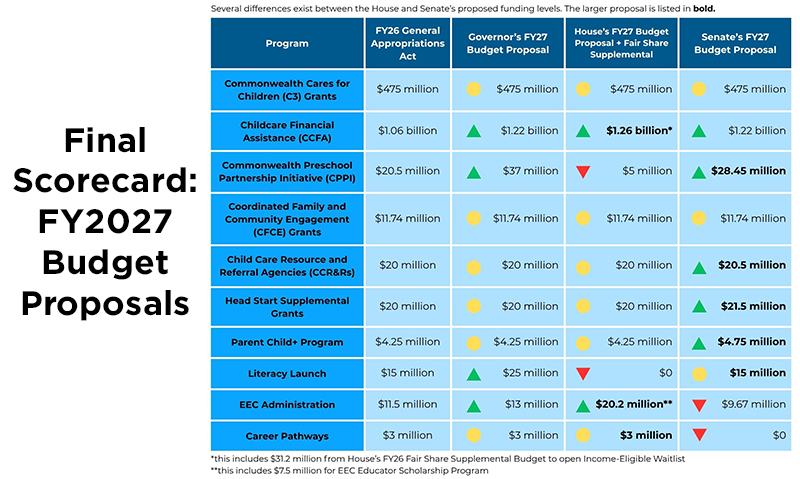
The Commonwealth Preschool Partnership Initiative (CPPI) helps school districts and early education and care programs develop partnerships to increase access to high-quality early learning in Gateway Cities. In the Senate’s budget proposal, they allocate $28.5 million for this program, which includes funding for the Summer Step Up program.
This is an $8 million increase over FY26, and a significant increase from the House’s proposal of $5 million.
Other major increases came through the Senate’s amendment process, where lawmakers submit and vote on “edits” to the initial budget draft. Even though there was a small pot of additional funding to allocate through this process, early education and care champions successfully bolstered funding for a few key programs.
The Head Start Supplemental Grant received an increase of $1.5 million. This money helps bridge the gap between what the federal government provides for Head Start and the actual program costs. While federal uncertainty looms, increasing state support for Head Start programs which serve our state’s most vulnerable populations is critically important.
Both Child Care Resource and Referral Agencies and the Parent Child+ home visiting program received an increase of $500,000 over FY26, helping them carry out their critical family support work.
Level-Funded: Childcare Financial Assistance Income-Eligible Waitlist, Literacy Launch and More
Child Care Financial Assistance (CCFA), our statewide childcare subsidy program, helps ensure that all families can afford early education and care, regardless of income. The program received the necessary funding to meet the expected increase in demand for the legal-entitlement arm of the program and cover the current caseload, but the Income-Eligible arm of the program did not receive a funding increase that would allow the waitlist to open.
Across the Commonwealth, more than 30,000 children remain on that waitlist.
They are unable to access the early education and care programs needed to support their development and allow their families to work or attend school and support their household, communities, and wider state economy.
Literacy Launch also received level-funding compared to FY26; however, this program was not included in the House’s budget, so the Senate’s level-funding would be a win for the field if included in the final budget.
The Commonwealth Cares for Children (C3) program and Coordinated Family and Community Engagement (CFCE) grantees (including Worcester Family Partnership), were level-funded. Both these programs were also level-funded in the House’s budget proposal, making additional funding during Conference Committee negotiations unlikely.
Some Cuts: EEC Administration and Career Pathways
The Department of Early Education and Care’s administrative line-item received a substantial budget cut in the Senate’s proposed budget, coming in at just under $10 million.
This money supports their staffing so that they can do essential licensing, policy, research, and community engagement work that is the backbone of the sector. A funding cut could put that work in jeopardy.
Additionally, the Career Pathways program did not receive any funding in the Senate’s budget proposal. This program directs funding to Massachusetts’ community colleges so that they can provide coursework, textbooks, student support, and more to current and future early childhood educators. This cut would be a substantial loss for the workforce system if reflected in the final budget.
Final Score Card
The Senate made several strong commitments to early education and care, but left essential programs that support access, affordability, and quality with level-funding.
One Last Push: Conference Committee Advocacy
Now that both the House and Senate have completed their individual budgeting processes, it’s time for the two chambers to come to a compromise between the two. For early education and care, there are several areas where the two chambers’ budgets differ in meaningful ways.
The Conference Committee is made up of three members of the House and three members of the Senate. Throughout the month of June, they will negotiate a compromise for each line-item that differs between House and Senate versions. To help ensure that robust funding is allocated for early education and care programs so that the children and families they serve can thrive, it is critical to reach out to these legislators to advocate for the programs you care about.
To help get a strong early education and care budget over the finish line, you can:
Call or email Conference Committee legislators. The committee includes Representatives Aaron Michlewitz, Kip Diggs, and Todd Smola, and Senators Michael Rodrigues, Joanne Comerford, and Patrick O’Connor. Introduce yourself, encourage them to choose the larger dollar amount for every early education and care program, and share why those investments are important to you. Every call and email is logged and read. Your voice helps legislators decide what is most important and where to invest limited budget dollars.
Join the conversation about the budget. Strategies for Children and Neighborhood Villages will co-host another installment of their Budget Breakdown Series on June 10. Translation will be provided from English to Spanish and Portuguese.
At Edward Street, we’re focusing our advocacy efforts on programs that address access and quality in early education and care. We’re following the FY27 budget process closely, so check back on our blog and follow us on Facebook and LinkedIn to stay informed.
Sierra Rainville is the Early Childhood Policy Pathways Fellow at Edward Street. Throughout the year, she’ll be sharing guest blog posts on topics connected to policy and advocacy. If you have ideas or questions she could address in these pieces, send her a message at srainville@edwardstreet.org.