

Happy Budget Season! On January 28, Governor Maura Healey released her state budget proposal, kicking off the budget negotiation process for Fiscal Year 2027.
This is just the first step in a marathon process which runs for several months until a final budget agreement is reached in July. Along the way, we’ll be sharing information about how our state dollars are allocated for early education and care, and what that means for children, families, and educators, so stay tuned here on our blog for updates.
For educators, parents, and anyone who has a stake in the wellbeing of our children, this is an important time for advocacy. Your voice matters. Our state’s budget determines the funding levels for many programs that help children and families thrive. It’s an expression of our state’s values and priorities.
It can be a confusing process; there are many steps, many iterations of the budget, and thousands of line items. Let’s break it down.
What do I need to know to understand the State Budget process?
The state’s budget process runs on a Fiscal Year (FY) calendar, rather than a standard calendar year. The fiscal year runs from July 1 to June 30 and is named for the calendar year in which it ends.We’re in Fiscal Year 2026 (FY26) and are working on the budget for Fiscal Year 2027 (FY27), which begins this July.
To get to the final state budget, called the General Appropriations Act (GAA), the Governor and both chambers of the legislature (the House of Representatives and the Senate) each take a turn developing a budget proposal. In June, leaders of each chamber meet to come to a compromise on the budget. That budget heads back to Governor Healey for final approval and signing by July 1.
Each chamber has its own Ways and Means Committee (sometimes they work together as the Joint Ways and Means Committee), which specifically focuses on the budget. These committees take the lead in developing the first draft of their respective chamber’s budget proposal and working on the compromise.
Like any budget, the state’s budget includes both expected earnings and planned spending. The state’s expected earnings for the fiscal year, or the Consensus Revenue Estimate, is determined by the Joint Committee on Ways and Means in December. The Governor and legislators use this information to guide their budget proposals and ensure that expected earnings and planned spending balance.
When advocates talk about the budget, we’re mostly focused on how the state plans to spend its money. Spending is divided into chunks called line-items, which each refer to a specific program, office, or service. Some programs, such as Child Care Financial Assistance, are broken down into multiple line items.
A final item to note is that in addition to the FY27 budget proposals, separate, supplemental budget proposals are also submitted to allocate surplus revenue from the FY25 Fair Share Surtax. This millionaire’s tax was passed by voters in 2022, and its revenue is required to be used for education or transportation. In both FY24 and FY25, we collected more revenue than we budgeted for, creating a surplus to be allocated. In Governor Healey’s proposal, $150 million is allocated to early education and care, which is used in her FY27 Budget proposal to fund a few programs.
Putting pen to paper: How does the budget process work?
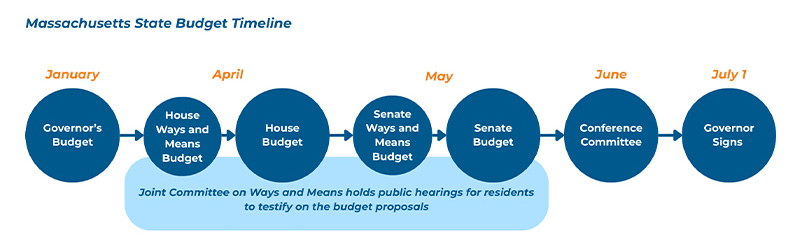
The Governor makes her proposal first.
On the third Wednesday in January, the Governor submits her budget and sends it to the House Ways and Means Committee. This year, the Governor’s Budget is called House 2; it’s sent to the House, and it’s the second year of the legislative session.
The House works on the budget next.
The House Ways and Means Committee takes a first pass at making adjustments to the Governor’s budget. Based on the Governor’s budget, public hearings, and other considerations, they create the House Ways and Means Budget and share it with the full House for review. House members can suggest changes (or amendments) to this budget. After debate, House members vote on those amendments, which are then reflected in the House’s final budget. The House Budget is then sent to the Senate, usually by the end of April.
The Senate drafts their budget proposal last.
A similar process is carried out in the Senate. The Senate Ways and Means Committee develops their budget proposal. Then the full Senate delegation reviews and debates this version of the budget and suggests and votes on amendments to create the Senate Budget. This is usually completed by the end of May.
While the House and Senate are working on their proposals, the Joint Committee on Ways and Means hosts public hearings so that residents of the Commonwealth can share their thoughts and priorities. Legislators take this information into consideration when developing their proposals and writing or voting for amendments.
The Legislature comes to a compromise, and the Governor signs off.
After the Senate submits their budget proposal, the House and Senate must work together to come to a compromise between the three proposals. The Conference Committee, made up of three delegates from each chamber, reviews the House and Senate Budgets. For each line-item with a difference in language or funding, the Conference Committee chooses between the House or Senate version, creating the Conference Committee Budget. This budget is returned to the full House and Senate, where delegates have an opportunity to vote to either pass or reject the bill.
Once the Conference Committee budget is approved by both the House and Senate, it is sent back to the Governor. She has 10 days to review the budget, and either sign it for approval, or veto specific items. In the case of a veto, it is returned to both the House and Senate, where they have a chance to accept or vote to override that veto(s).

How can I be an advocate for early education and care?
Learning about how the budget works is a great first step to being a strong advocate for early education and care. Your voice matters, and each step in the budget process provides an opportunity for advocacy.
Call or email your legislators. Click here to find their contact information, introduce yourself and share why investments in early childhood are important to you. Every call and email is logged and read. Your voice helps legislators decide what is most important and where to invest limited budget dollars.
Join the conversation about the budget. Sign up for the Budget Breakdown Series, hosted by Strategies for Children and Neighborhood Villages, for a detailed review of each budget proposal and next steps in the process. These virtual meetings will be hosted on May 7 and June 10, and translation will be provided from English to Spanish and Portuguese.
At Edward Street, we’re focusing our advocacy efforts on programs that address access and quality in early education and care. We’re following the FY27 budget process closely, so check back on our blog and follow us on Facebook and LinkedIn for updates. We’ll be sharing a review of Governor Healey’s budget proposal here on the blog next week, and reviews of House, Senate, and Conference Committee proposals later in the process. Stay tuned!
Sierra Rainville is the Early Childhood Policy Pathways Fellow at Edward Street. Throughout the year, she’ll be sharing guest blog posts throughout the year on topics connected to policy and advocacy. If you have ideas or questions she could address in these pieces, send her a message at srainville@edwardstreet.org.