
Welcome back to The Science of Early Childhood Development series! Previously, we shared about ecological systems theory and the basics of how young children’s brains develop. Today, we’ll talk about one of the most important factors in a child’s development: relationships with their caregivers.
Children develop in an environment of relationships. Human brains are social; we are wired to build these relationships and learn from our interactions with others. Caregivers – parents, educators, and other important adults in a child’s life – help build the relationships that support learning and growth.
“Every child needs at least one adult who is irrationally crazy about him or her.”
-Dr. Urie Bronfenbrenner
What Are Developmental Relationships?
Developmental relationships promote healthy development in early childhood and throughout the life course. Dr. Junlei Li, Saul Zaenz Senior Lecturer in Early Childhood at Harvard Graduate School of Education, refers to them as the “active ingredient” in human development, and emphasizes that interventions that support child development are successful only when they strengthen a child’s developmental relationships. These unique relationships are characterized by a few features: enduring emotional attachment, serve-and-return interactions, increasing complexity of shared activities, and a gradual shift in the balance of power.
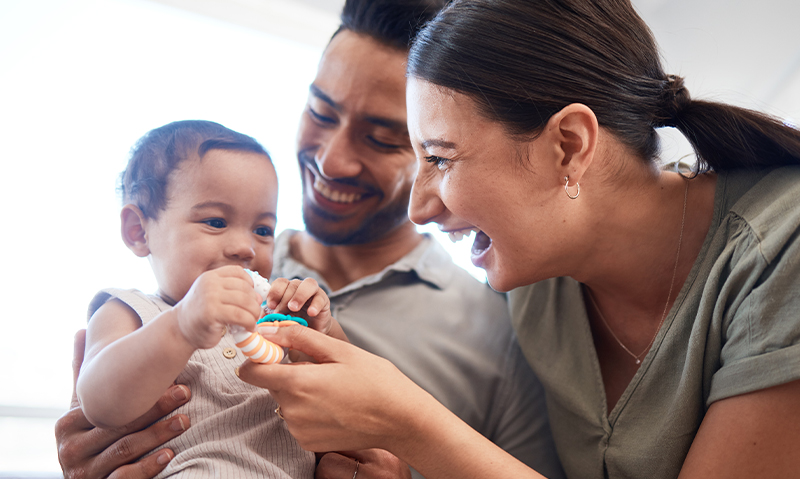
Enduring Emotional Attachment
First, developmental relationships require a sustained emotional attachment, such as between a child and parent or other long-term caregiver. These strong attachments, and the positive interactions that help build them, help a child feel secure. This security creates a foundation for learning.
Serve-and-Return Interactions
Developmental relationships also require reciprocal interactions, or serve-and-return interactions. These are back-and-forth exchanges between two people that are key building blocks for developmental relationships and early learning. In the early years, many of these interactions will be between a child and an adult, but these interactions can occur between two children too.
The essential feature of these responsive interactions is right in the name: serve, and return. Like a tennis game, someone makes the first serve, such as a baby making a cooing sound, a toddler pointing to a bird nearby, or a preschooler asking a parent to play. By first noticing the child’s serve, then responding to it, the adult returns, such as by repeating the cooing sound, talking about the color of the bird, or suggesting a game to play together! By taking turns like this, you’re helping your child learn about the activity or skill they’re practicing, as well as about how to connect with others.
Increasing Complexity & Gradual Shift in Power

Another feature of a developmental relationship is that the shared activities should become increasingly more complex to give children the opportunity to continue to learn more and more, and for the balance of power to shift towards the child. This might sound complicated but is likely quite intuitive; as children learn, we see the opportunity to present new experiences and challenges, and their learning gives them greater independence and power along the way.
For example, as a child begins taking steps, a parent may provide support by holding the child, but as they begin to build their confidence and skills, the parent’s touch can gradually fade. This provides the child with an increasingly more challenging task (that is appropriate to their developmental stage) and a greater amount of power and independence in the interaction.
Responsive Caregiving
The magic of these relationships is in the attentiveness of the caregiver. Responsiveness helps children feel safe and secure. To start and sustain serve and return interactions, caregivers must be attentive to the child’s focus, cues, and interests. And to make the interactions more complex and provide the child with more power over time, adults must be attuned to the child’s development and the appropriate difficulty of activities to present and support to offer. All of these features require responsive caregiving: providing appropriate, prompt, and consistent responses to children’s needs.
Children feel safe when they know their caregiver is responding to their needs. When a child feels safe, they have the capacity to explore and learn from the world around them. And, this supports their ability to build strong relationships with others in the future.
How Can I Strengthen Developmental Relationships?

If you have a young child in your life, strengthening your relationship with them through shared activities and responsiveness will help them thrive. Engage in opportunities for learning together by talking to them, playing with them, singing to them, and paying attention to and responding to what they’re interested in! To learn more, the Simple Interactions Tool, created by Dr. Junlei Li, offers an opportunity to reflect on the quality of your interactions with children.
Even if you don’t have a child in your life, you can make a positive impact on children’s developmental relationships by supporting caregivers. Making it easier for them to build developmental relationships with the children they care for will help those children to learn, grow, and thrive.
You can use your voice and your votes to support practices and policies that help children and their caregivers. This might include paid parental leave, workplace flexibility, higher wages for early childhood educators, and more to ensure that those with the most enduring connection with our community’s children have what they need to focus deeply on the children in their care.
When children don’t have a strong relationship with at least one adult in their life, they are at risk for negative developmental outcomes. In our next and final installment of this series, you can learn more about the risks of toxic stress and how resilience can support children in the face of challenging times, and how their caregivers support that resilience.
Check out our other blogs and follow us on Facebook(link is external), Instagram(link is external), and LinkedIn(link is external) for more updates.