

The state budgeting process for Fiscal Year 2027 (FY27) has come to a close! After seven months of drafts, debate, amendments, and negotiations, Governor Maura Healey signed a $63.4 billion state budget on July 9. The final budget includes $1.9 billion across line items administered by the Department of Early Education and Care (EEC), supporting a variety of programs that promote access, affordability, and quality. Your advocacy helped make this possible.
If you’ve been following the budget development process, you’ll know that the House and Senate drafts proposed funding increases for some EEC line items and cuts for others. At the end of the day, the final compromise budget signed into law offers level funding across nearly every early education and care line item, with a few notable exceptions.
In a time of financial uncertainty, Edward Street applauds Beacon Hill’s recognition of the importance of early education and care. However, those few cuts, and the rising costs that threaten the stability of level-funded programs, will impact children and families in Worcester and beyond.
Most EEC Line Items Will Receive Level Funding

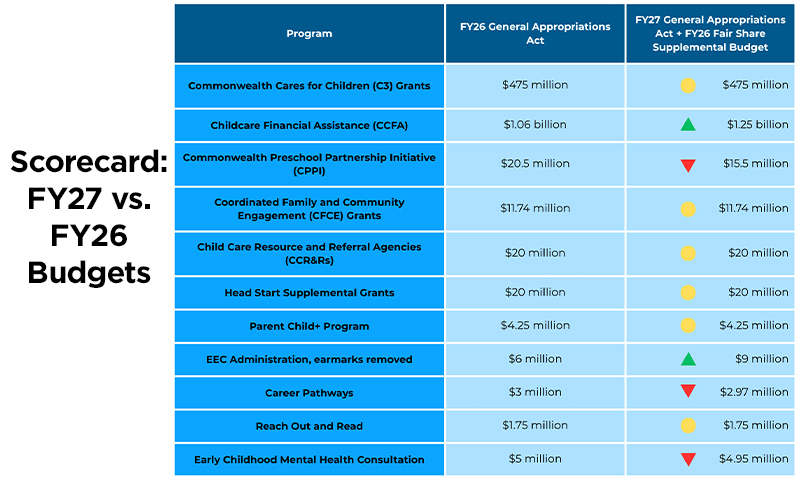
Many of the line items for critical early education and care programs were level-funded, receiving the same amount of funding in FY27 as they did in the FY26 budget.
These include Commonwealth Cares for Children (C3), Child Care Resource and Referral Agencies (CCR&Rs), Supplemental Grants to Head Start Programs, ParentChild+ Programs, Coordinated Family and Community Engagement Grantees (CFCEs), and Reach Out and Read.
This is a clear signal from legislators that early education and care is a priority; given the challenging financial environment, a last-in/first-out approach might have been taken, putting critical EEC items on the line.
Sounding the Alarm: Rising Costs, but Funding Stands Still
While early education and care line items largely avoided the chopping block, level funding still poses challenges. As costs rise but funding doesn’t, programs will need to get even more creative to maintain the status quo or make difficult decisions and scale back.
One example is the C3 program. This non-competitive grant program’s goal is to stabilize the state’s early education and care programs. With hundreds of new providers looking to join C3 and the rising costs faced by existing grantees, the $475 million annual allocation isn’t keeping up.
EEC is faced with a difficult choice: retain the current grant award formula and keep new providers out or change the formula to allow more providers to join, but lower grant awards overall.
A Few Cuts

Funding for the Commonwealth Preschool Partnership Initiative (CPPI) was cut by $5 million compared to FY26. This will translate into 30% budget cuts for all CPPI communities, requiring them to make difficult choices about services offered.
These cuts will affect Worcester, negatively impacting children, families, and early education and care programs.
Worcester uses CPPI dollars to strengthen connections between community-based early education and care classrooms and Worcester’s Public Schools’ pre-K program. Through curriculum alignment, professional development, and the creation of an itinerant special education team, CPPI has strengthened Worcester’s mixed-delivery early childhood ecosystem and increased opportunities for all children to attend preschool.
The Worcester CPPI Leadership Team is hard at work figuring out how to maintain these critical direct services for children, even in the face of significant cuts to funding.
Additionally, EEC’s Career Pathways Program and Early Childhood Mental Health Consultation Services faced minor cuts of $30,000 and $50,000, respectively.
A Few Increases
A record $1.2 billion was allocated for Child Care Financial Assistance (CCFA) to support the current caseload and anticipated increases in the DTA/DCF caseload, the entitlement arms of the program. Legislators also allocated an additional $31.2 million in the FY26 Fair Share Supplemental Budget to reduce the income-eligible CCFA waitlist, most of which will be spent in FY27. This brings total CCFA total funding to $1.25 billion across both budgets.
The EEC administrative line item, which supports EEC’s staff and other operational costs, did receive an increase in the FY27 budget. However, this increase will only partially restore funding lost in the FY26 budget, leaving the agency in a challenging financial position.
Reflections & Next Steps
Now that the budget is finalized, it’s time to look back and look ahead.
An important part of advocacy is cultivating relationships with government leaders. Although there is still room for growth, this year’s budget makes record investments in early education and care infrastructure across the state. Whether or not you contacted your legislators during the budget development process, now is a great time to send a message thanking them for investing in children, families, and educators.
Find your legislator here and write them an email, give them a call, or reach out to schedule an in-district meeting to talk to them face to face.
If there is a particular line item you care about, you can get into the specifics in your message. To help you craft your message, you can take a look at our previous blog posts in this series to review what EEC programs the House and Senate prioritized. Or take a holistic approach and offer your thanks for helping make sure children, families, and educators thrive by funding early education and care programs in the budget.
With budget season behind us, advocates can turn their full attention to other parts of the early childhood policy world. Here are a few next steps you can take to stay involved:
- Contact your federal delegates to schedule a meeting or visit to your program while they are in-district on their August Recess.
- Two important elections are upcoming, so make sure you’re registered to vote. The State Primary is on September 1, and the State Election is on November 3. Many important offices and issues will be on the ballot.
Finally, sign up for a new Edward Street policy newsletter, so you can stay up to date with the latest local, state, and federal policy updates on all things early childhood.
Check out our other blogs and follow us on Facebook, Instagram, and LinkedIn for more updates.
Sierra Rainville is the Early Childhood Policy Pathways Fellow at Edward Street. Throughout the year, she’ll be sharing guest blog posts on topics connected to policy and advocacy. If you have ideas or questions she could address in these pieces, send her a message at srainville@edwardstreet.org.