

On January 28, Governor Maura Healey released her $62.8 billion state budget proposal, kicking off the budget negotiation process for Fiscal Year 2027.
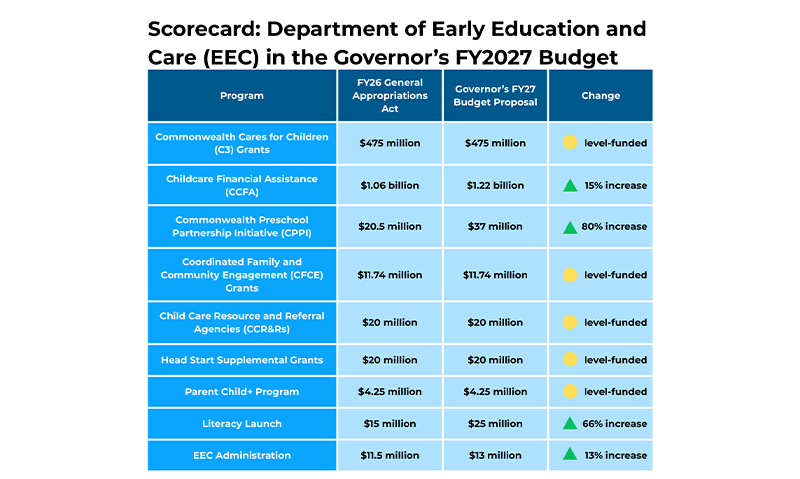
Governor Healey’s FY27 proposal allocates $1.9 billion to the Department of Early Education and Care (EEC), a 10.6% increase over the FY26 budget. This budget year was tight, as federal policy changes and uncertainty required Massachusetts to fill new gaps in healthcare, nutrition, and housing. With this context in mind, Governor Healey proposed funding that maintains key early childhood education and care programs, but without the funding increases needed to deliver on our promises to help every child and family thrive.
Commonwealth Cares for Children (C3): Level-Funded
The Commonwealth Cares for Children (C3) program, an operational grant program born out of pandemic-era ARPA funding, was level-funded at $475 million for the third year in a row. Massachusetts has made a unique and commendable investment in childcare programs through this flexible operational funding. However, level funding creates two major problems. First, operating costs have risen for providers over the last three years, but funding has not. Second, without new funding, over 600 new early education and care providers cannot participate in the program unless grant awards are decreased for current providers.
Child Care Financial Assistance (CCFA): Moderate Increase to Maintain Current Caseload
The Child Care Financial Assistance program is our state’s childcare subsidy program, helping families afford childcare and out of school time programs. It received an increase of $133 million over FY26 for a total of $1.22 billion, split between the Department of Transitional Assistance (DTA), Department of Children and Families (DCF), and Income Eligible programs. This funding level will allow EEC to continue to serve the current caseload and the anticipated increase in DTA/DCF caseload, but will not allow for opening access to new vouchers or contract slots through the Income Eligible program. This is the third year that the Income Eligible program has been frozen, and the waitlist for subsidized care will continue to grow. As of February 2, 1,329 Worcester children sit on the waitlist.
Commonwealth Preschool Partnership Initiative (CPPI): Significantly Increased Funding
The Commonwealth Preschool Partnership Initiative (CPPI) is part of Governor Healey’s Gateway to Pre-K Agenda. It helps school districts and early education and care programs develop partnerships to increase access to high-quality early learning in Gateway Cities. Healey proposed a significant increase in funding for this program, allocating $37 million — a $16.5 million increase over the FY26 budget. This line-item does include funding for the Summer Step Up program, so not all $37 million will be spent directly on CPPI. In her State of the Commonwealth address, she reiterated her goal to have universal pre-k in every Gateway City by the end of 2026 and shared her optimism for getting this accomplished ahead of schedule.
Other Programs: Mostly Level-Funded, Some Increases
Programs including Coordinated Family and Community Engagement grantees, Child Care Resource and Referral Agencies, Head Start programs, and the Parent Child+ program were recommended to receive level-funding.
The Literacy Launch program received $25 million, a $10 million increase over FY26. This program is part of Governor Healey’s plan to improve early literacy education across the Commonwealth. The Department of Early Education and Care’s Administrative line-item, which supports staffing, increased to $13 million, an increase of $1.5 million compared to FY26.

Final Score Card
For early education and care and the FY27 budget, good things are happening in small ways. EEC programs saw no funding cuts; in this challenging economic climate, that’s a win.
Some programs saw substantial growth. Preschoolers in Gateway Cities will reap the benefits of CPPI’s expansion, the most in-need children will benefit from funding increases to Childcare Financial Assistance for the DTA and DCF programs, Literacy Launch will help support high-quality literacy instruction, and supporting EEC’s staffing needs makes their important work possible.
However, with broad level-funding, no growth can be made, and each dollar we give providers doesn’t stretch as far as it did in previous years. Our children can’t wait; every day of frozen funding for early education and care is a missed opportunity to invest deeply in the most transformative phase of a child’s life.
How can I continue to be an advocate?
Now that the budget is in the hands of the legislature, direct your advocacy efforts towards them. Your voice matters, and it’s not too early!
Call or email your legislators. Click here to find their contact information, introduce yourself and share why investments in early childhood are important to you. Every call and email is logged and read. Your voice helps legislators decide what is most important and where to invest limited budget dollars.
Join the conversation about the budget. Sign up for the Budget Breakdown Series, hosted by Strategies for Children and Neighborhood Villages, for a detailed review of each budget proposal and next steps in the process. These virtual meetings will be hosted on May 7 and June 10, and translation will be provided from English to Spanish and Portuguese.
At Edward Street, we’re focusing our advocacy efforts on programs that address access and quality in early education and care. We’re following the FY27 budget process closely, so check back on our blog and follow us on Facebook and LinkedIn for a review of the next budget proposals.
Sierra Rainville is the Early Childhood Policy Pathways Fellow at Edward Street. Throughout the year, she’ll be sharing guest blog posts throughout the year on topics connected to policy and advocacy. If you have ideas or questions she could address in these pieces, send her a message at srainville@edwardstreet.org.